Planning a trip to the White Desert from Cairo usually raises the same practical question: how much time do you actually need, and what does the trip look like day by day? A 2-day, 1-night White Desert Egypt itinerary is one of the most common formats for travelers based in Cairo, since it balances the long road transfer with enough time in the desert to see it properly, including a night under the stars.
This article walks through what a typical 2-day, 1-night White Desert itinerary involves, from departure in Cairo to the return journey the following day. Exact timings, stops, and inclusions can vary depending on the tour operator, road conditions, weather, and the specific itinerary you book, so the schedule below should be read as a general framework rather than a fixed timetable. For background on the White Desert itself, camping options, and pricing, see our complete White Desert Egypt guide.
For most travelers, yes. A 2-day, 1-night itinerary allows enough time to reach the White Desert, explore its rock formations by 4x4, and stay overnight, which a single-day trip cannot offer.
The overnight stay is what sets this itinerary apart from a same-day visit. Instead of turning back once the sun sets, travelers camp in the desert, which means experiencing sunset, the evening sky, and sunrise the following morning — three parts of the White Desert that a one-day trip simply skips. The desert also looks different depending on the light, so seeing it in the late afternoon and again early the next morning gives a broader sense of the landscape than a few daytime hours alone.
This itinerary is not meant to cover every corner of the Western Desert in depth (that generally requires a longer trip), but for travelers who want a practical, well-rounded introduction to the White Desert, 2 days and 1 night is typically enough.

| Time / Period | Day 1 | Day 2 |
| Early morning | Departure from Cairo/Giza | Sunrise in the White Desert |
| Morning | Long drive toward Bahariya Oasis | Breakfast at the campsite |
| Late morning | Arrival in Bahariya; transfer to 4x4 where applicable | Morning desert exploration |
| Afternoon | Black Desert and Crystal Mountain stops | Pack up camp |
| Late afternoon | White Desert exploration | Return drive to Bahariya |
| Evening | Sunset, dinner, overnight camping | Drive back to Cairo |
The order and duration of each stop can shift depending on the operator's schedule, the season, and road or weather conditions on the day.
Most White Desert trips begin with an early departure from Cairo or Giza, since the journey to Bahariya Oasis takes several hours by road. Travelers are typically picked up from their hotel and driven west across the desert highway toward the oasis.
The drive itself is fairly straightforward, passing through open desert scenery with limited stops along the way. Some itineraries include a short break partway through the journey, though this depends on the tour and the group's schedule.
On arrival in Bahariya Oasis, the trip usually shifts from the standard vehicle used for the highway drive to a 4x4, since the terrain beyond the oasis requires off-road capability. This is also typically where drivers and guides prepare supplies for the desert leg of the trip, including water, food, and camping equipment. The exact sequence — whether the vehicle switch happens immediately or after a short stop in the oasis — varies by operator.
Not far from Bahariya, the route commonly passes through the Black Desert, an area where dark volcanic rock covers the hills and desert floor. It looks noticeably different from both the oasis and the White Desert that follows later in the day, which is part of why it's often included as a stop along the same route.
Travelers typically stop for a short walk or a viewpoint climb to take in the landscape before continuing. It's generally treated as a brief scenic stop rather than a lengthy excursion, since the main focus of the day is reaching the White Desert with enough daylight left for exploration.
Crystal Mountain is another common stop on the way to the White Desert. It's a small rock formation where quartz crystals are visible embedded in the stone, making it a popular short photo stop for travelers passing through.
Most itineraries allow 10 to 20 minutes here, just enough time to walk around, take photos, and continue the drive. It's worth noting this as a brief sightseeing stop rather than a major attraction in its own right — the same-day itinerary generally keeps moving toward the White Desert fairly quickly afterward.
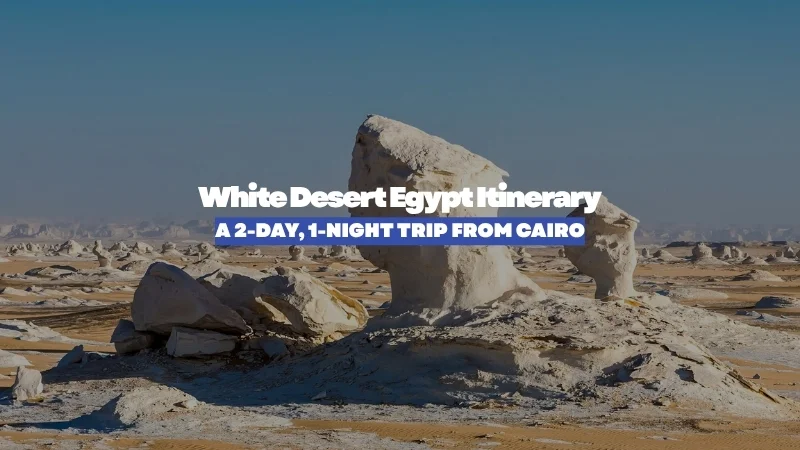
The White Desert itself is usually reached in the afternoon, and this is where the itinerary slows down. Travelers switch to full off-road exploration by 4x4, driving between the chalk-white rock formations that give the park its name.
Guides typically stop at several formations along the way, some of which have informal names based on their shapes. These stops are generally used for walking around the rocks and taking photographs, and the pace tends to be relaxed compared to the earlier part of the day.
As the afternoon progresses, the light starts to change, and this is often when the exploration route naturally works its way toward wherever the group will camp for the night. The specific formations visited and the order of stops depend on the guide, the itinerary, and current access conditions in the park, so no two trips follow exactly the same route.
Sunset is one of the more anticipated parts of the overnight itinerary. As the sun lowers, the white rock formations pick up warmer tones, and the changing light tends to make the landscape look different from how it appeared earlier in the day.
Many itineraries build in time to stop at a viewpoint or a cluster of formations specifically to watch the sunset, and this is typically a popular window for photography, since the shifting light and long shadows create different conditions than midday. Results vary depending on weather and season, so it's worth keeping expectations realistic rather than assuming a dramatic show every time.
Once the sun sets, the group usually moves to the campsite, marking the transition from the day's exploration to the overnight stay.
Camping is the core of the overnight experience. After sunset, most itineraries include a desert dinner prepared at the campsite, often cooked over a fire or a portable stove depending on the operator.
Sleeping arrangements typically involve tents, though the specifics — shared versus individual tents, mattress type, bedding — vary by tour and package, so it's worth confirming details with your operator in advance rather than assuming a fixed setup. Facilities in the desert are generally basic: there's usually no running water or standard bathroom infrastructure, and electricity, where available at all, is typically limited. Mobile coverage can be weak or absent in parts of the White Desert, so travelers shouldn't rely on a strong signal overnight.
A campfire is common where conditions and local regulations allow it, often serving as a gathering point after dinner. Because camping standards differ between operators, it's a good idea to ask specifically what's included — tents, bedding, food, and water — before booking, rather than assuming a particular standard of comfort.
One of the main reasons travelers choose the overnight itinerary over a single-day trip is the chance to see the desert sky after dark. With no significant light pollution nearby, considerably more stars are visible than in Cairo or other populated areas.
The clear, open horizon of the White Desert makes for a wide, unobstructed view of the sky, and many travelers use this time for night photography, though this generally requires a tripod and some familiarity with long-exposure settings. Conditions vary by season and moon phase, and visibility isn't guaranteed to be equally good on every trip, so it's reasonable to expect a good view rather than a perfect one.
Temperatures also drop noticeably after dark, particularly outside the summer months, so warm layers are essential for comfortably spending time outside the tent in the evening.

The second day typically starts early, with many itineraries built around catching sunrise directly from or near the campsite. As with sunset, the changing light in the early morning tends to highlight the White Desert's formations differently than during the previous afternoon.
After sunrise, breakfast is usually served at the camp, followed by a period of morning exploration. This is often a quieter, cooler time to walk around nearby formations and take further photographs before the day's heat sets in. Some itineraries use this window for a short additional 4x4 exploration of areas not covered the previous afternoon.
Once the group has finished exploring, camp is packed up — tents taken down, equipment loaded back into the vehicles — before beginning the return journey.
The return trip generally follows the same route in reverse: White Desert to Bahariya Oasis, then Bahariya to Cairo.
Travelers typically switch back from the 4x4 to the standard road vehicle in Bahariya before starting the long highway drive back to Cairo. Depending on the itinerary, there may be a short stop in the oasis for lunch or supplies before departure.
Arrival time back in Cairo varies depending on traffic, the number of stops along the way, road conditions, and how the specific tour is scheduled that day. It's best to treat the return as an afternoon or evening arrival rather than expecting a guaranteed time, especially if you have onward travel plans the same day.
Inclusions differ between operators and packages, but a typical 2-day, 1-night trip commonly covers:
Transportation to and from Cairo or Giza
4x4 transportation within the desert
A driver and/or guide
Meals during the trip (often dinner, breakfast, and sometimes lunch)
Drinking water
Basic camping equipment, such as tents
Any relevant park permits or entry fees, where applicable
Because inclusions vary significantly by operator, it's worth confirming exactly what's covered — and what isn't — before booking, rather than assuming a standard package.
Desert temperatures shift considerably between day and night, especially outside summer, so packing in layers matters more than packing heavily. A practical checklist includes:
Warm layers, such as a jacket or fleece, for the evening and early morning
Comfortable, closed shoes suitable for walking on sand and rock
Sunglasses and sunscreen for daytime exposure
A hat for sun protection during the day
A power bank, since charging options are often limited at the campsite
A torch or headlamp for moving around camp after dark
A camera and spare batteries, if photography is a priority
Personal toiletries, kept minimal given limited facilities
A small overnight bag rather than full luggage, since space in the 4x4 is often limited
Warm layers are worth emphasizing specifically: daytime temperatures in the desert can feel warm, but nights — particularly between late autumn and early spring — can drop significantly, and campsite heating is generally not available.

This itinerary tends to work well for:
First-time visitors to the Western Desert
Travelers already based in Cairo looking for a manageable overnight trip
Couples
Families comfortable with a long day of road travel
Photographers interested in sunset, sunrise, and night sky conditions
Travelers who specifically want the overnight desert experience rather than a rushed day trip
A longer itinerary may be worth considering if you'd prefer a slower pace, want more time to explore Bahariya Oasis itself, are interested in additional Western Desert stops beyond the standard route, or would rather spread the driving over more days instead of covering long stretches at once.
A one-day trip from Cairo is possible and is offered by some operators, but it comes with trade-offs compared with the 2-day, 1-night version.
A single-day itinerary generally covers the same core stops — Black Desert, Crystal Mountain, and White Desert exploration — but compresses them into a tighter schedule, since the group needs to complete the round trip to Cairo the same day. This usually means less time at each stop and no overnight camping, which rules out sunset viewing followed by dinner, stargazing, and sunrise the next morning.
The 2-day, 1-night itinerary, by contrast, allows a more relaxed pace and includes the overnight elements that many travelers specifically want from a White Desert trip. Neither option is universally better — the right choice depends on how much time you have available and whether the overnight camping experience matters to you.
How many days do you need for the White Desert?
Most travelers use 2 days and 1 night for a well-rounded visit, though shorter one-day trips and longer multi-day itineraries are also available depending on your priorities.
Is 2 days enough for the White Desert?
For most first-time visitors, yes. It allows time for 4x4 exploration, an overnight camp, sunset, stargazing, and sunrise, without requiring multiple days on the road.
Can I visit the White Desert from Cairo?
Yes. Most White Desert trips depart from Cairo or Giza, traveling via Bahariya Oasis before continuing into the desert by 4x4.
Does a 2-day White Desert trip include camping?
Typically, yes. The standard 2-day, 1-night format includes one overnight stay camping in the White Desert, though exact camping arrangements vary by operator.
What time does a White Desert tour leave Cairo? Departure times vary by operator, but early morning departures are common given the length of the drive to Bahariya Oasis. Exact times should be confirmed with your tour provider.
What should I wear for White Desert camping? Layered clothing works best — lighter clothing for daytime and warm layers for evening and early morning, along with comfortable closed shoes for walking on sand and rock.
Is the White Desert cold at night? Nighttime temperatures can drop significantly, particularly outside the summer months, so warm layers are recommended even if the daytime temperature felt mild.
If you're considering a 2-day, 1-night trip to the White Desert, Kadmar Travel can help put together an itinerary based on your dates, group size, and whether you'd prefer a private or group experience. Share your preferred travel dates and group details, and we can help plan a schedule that fits your trip. For more general background on the White Desert, camping, and pricing, see our White Desert Egypt tours and camping guide.
Ready to embark on your Egyptian adventure? Contact Kadmar Travel today and let us turn your travel dreams into reality.
Reach out to our dedicated team at Inbound@kadmartravel.com or call us at +2034839726
Reach out to our dedicated team at Inbound@kadmartravel.com, call us at +2034839726, or contact us through WhatsApp at +201286739037.
Don't just visit Egypt; experience it with Kadmar Travel
Or fill out the form below and we will call you back for any information needed.