
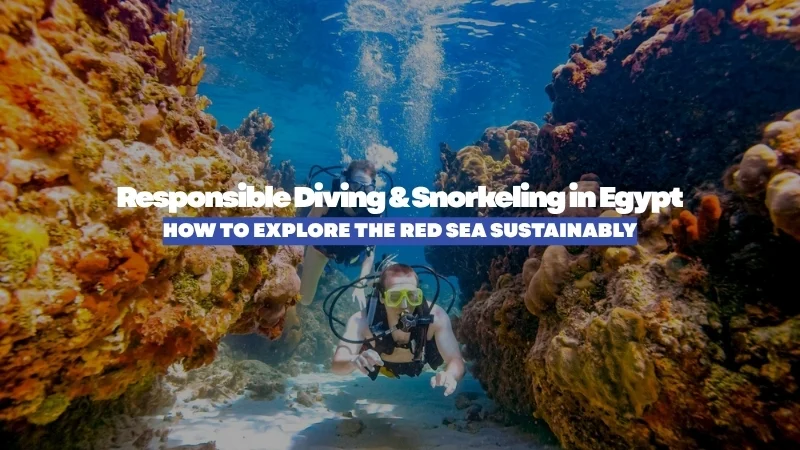
The Red Sea draws divers and snorkelers for good reason: warm, clear water, easy access from shore or boat, and reefs that sit close to some of Egypt's most developed coastal towns. That accessibility is also the reason responsible behavior matters here. A marine excursion isn't automatically low-impact simply because it takes place in nature — a reef visited by well-briefed, careful divers on a well-run boat is a very different experience, environmentally, from the same reef visited carelessly.
Responsible diving and snorkeling in Egypt come down to two things working together: how the experience is operated, and how visitors behave once they're in the water. This guide looks at both — what to check before booking a dive or snorkeling trip, how to act responsibly once you're there, and how these choices fit into a broader Red Sea itinerary.
Egypt's Red Sea coast supports a large and long-established diving and snorkeling industry, built around coral reef systems that draw visitors from around the world. Coral reefs are slow-growing and sensitive to physical contact, and marine wildlife can be disturbed by careless or overly persistent human interaction. None of that means diving or snorkeling is inherently harmful — the environmental impact depends heavily on how marine activities are managed and how visitors behave in the water.
Tourism itself is not inherently harmful, but its environmental impact depends on how visitor activity is managed and how people behave. Protected areas such as Ras Mohammed National Park near Sharm El Sheikh and Wadi El Gemal National Park near Marsa Alam combine conservation objectives with regulated visitor access and tourism activities. The environmental pressure that does exist tends to come from a combination of factors — high visitor volume at popular sites, inconsistent operator practices, and visitor behavior that isn't well guided. Operators and guides play a central role here, since they're the ones who set expectations, brief groups, and manage what happens in the water in real time.
A handful of practical factors separate a well-run marine excursion from a poorly managed one.
The basics are simple but make a real difference: no touching coral, no standing on the reef even briefly, and avoiding fin kicks that stir sediment or make contact with coral structures. Good buoyancy control and body positioning reduce accidental contact, which is one reason briefings and guide supervision matter as much as individual awareness.
Responsible interaction with marine life means not feeding animals, not chasing or attempting to touch them, and keeping a reasonable distance rather than crowding around something interesting. Guides are typically the best source of real-time direction here — following their instructions around wildlife, rather than acting independently, keeps encounters lower-impact for the animal.
How a boat moors matters. Using designated mooring points where they exist, rather than dropping anchor directly onto a reef, reduces physical damage to coral. Not every operator in Egypt follows the same standard, so this is a reasonable thing to ask about rather than assume.
Sensible waste management onboard, a reduction in disposable plastics, and a clear system for making sure nothing ends up in the sea are practical signs of a well-run trip, and one of the more visible things a visitor can observe firsthand.
Refillable drinking-water systems, where genuinely available, reduce the number of disposable bottles a boat goes through on a single trip — a small detail, but a checkable one.
How many people are in the water at once, and how closely a guide can supervise them, affects reef contact, wildlife disturbance, and the overall quality of the experience. A smaller group isn't automatically more sustainable, though — a small, poorly briefed group can still cause disturbance, while a larger group with strong guide-to-visitor ratios and clear structure can be well managed. Group size is one factor to weigh, not a guarantee on its own.
A responsible operator should walk guests through the basics before entering the water: reef rules, expected wildlife behavior, any protected-area requirements specific to the site, and what visitors should and shouldn't do. The existence and quality of this briefing is one of the more telling signs of how seriously an operator treats the environmental side of the trip.
Guides matter for more than safety. A guide who understands the local marine environment can shape group behavior in the moment — steering people away from fragile areas, correcting poor buoyancy, and explaining why certain rules exist rather than simply enforcing them.

The most useful approach is to look for evidence, not just the word "eco" in a listing or brochure. A few specific questions are worth asking directly.
Environmental policy. Does the operator explain its environmental practices in concrete terms, or only in general statements?
Reef-protection practices. Does it brief guests on coral contact, buoyancy, wildlife behavior, and any protected-area rules specific to the site?
Waste practices. What happens to plastic bottles, food packaging, and other waste generated during the trip?
Group management. How are excursions organized, and how do guides manage groups once everyone is in the water?
Staff training. Is there evidence that guides understand the local marine environment and can speak knowledgeably about responsible visitor behavior?
Wildlife rules. Does the operator have clear rules against feeding wildlife, touching animals, chasing marine life, or collecting anything from the sea?
Conservation involvement. If an operator says it supports conservation work, it's reasonable to ask who the partner organization is, what the involvement actually consists of, and whether there's public information about it. An operator that can't answer isn't necessarily acting in bad faith — smaller operators may support local initiatives informally — but the answer still tells you something useful about what's behind the claim.
A label on its own doesn't tell a traveler much. The more useful exercise is looking past the word and asking what's actually behind it.
Worth looking for: specific operational practices rather than general statements, a written environmental policy, relevant certifications where an operator holds one, named conservation initiatives rather than vague references to "supporting the environment," measurable information where it's genuinely available, and clear, direct explanations rather than marketing language.
There's a real difference between a statement like "we care about the environment" and a specific, verifiable practice — for example, a described process for how boats moor to avoid reef contact, or a stated policy on refillable water systems. The first tells you very little. The second gives you something to actually evaluate.
Two things are worth holding in mind here. First, the absence of a public certification doesn't automatically mean an operator is irresponsible — plenty of smaller, careful operators simply haven't pursued formal certification. Second, having a certification doesn't automatically mean an entire excursion is sustainable across every dimension covered in this guide; a certification usually covers specific criteria, not the whole operation. The goal in both directions is the same: look for evidence and transparency, not the presence or absence of a single label.
This isn't a question of which destination is "better" for responsible diving — each has a different profile, and the responsible choice depends more on the specific operator, site, and visitor behavior than on the town itself.
Hurghada has one of Egypt's longest-established tourism and diving industries, with a correspondingly high volume of marine excursions departing daily. That scale makes operator practices and visitor behavior especially relevant — the number of boats and divers visiting popular sites means the cumulative effect of how each one operates matters more than it might in a quieter location.
Marsa Alam sits close to Wadi El Gemal National Park, a protected area combining desert and marine environments. That proximity makes following local environmental rules and operator guidance particularly relevant to how responsibly a marine trip is run.
Sharm El Sheikh sits near Ras Mohammed National Park, a long-established protected marine area with specific rules around anchoring, wildlife interaction and visitor conduct. Significant visitor interest in the area makes it worth confirming, before booking, how a specific operator handles these site-specific requirements rather than assuming standard practice applies everywhere.
None of these destinations is inherently more or less responsible than the others. The experience a traveler ends up with depends on the specific operator, the specific site, and how carefully the trip is run and behaved in — not the name of the town it departs from.

A practical way to think about this is by stage of the trip.
Before the trip: research the operator, ask the sustainability questions outlined above, understand any local rules for the specific site you'll be visiting, and choose an experience that matches your priorities rather than booking on price alone.
During the boat trip: reduce disposable plastic where practical, use refillable water systems when they're offered, follow crew instructions, and dispose of any waste properly rather than assuming someone else will handle it.
In the water: don't touch coral, don't stand on the reef even briefly, maintain good buoyancy, avoid kicking coral with fins, don't feed marine animals, don't chase or attempt to handle wildlife, and keep an appropriate distance from anything you're observing.
After the experience: avoid buying products made from protected marine wildlife, don't remove coral, shells, or other marine life where this is prohibited, support legitimate local businesses and conservation initiatives where the opportunity is genuine, and share what you've learned about responsible practice with other travelers rather than assuming it's obvious.
Choosing accommodation with credible environmental practices is a genuinely useful step, but the sustainability of a Red Sea holiday doesn't stop at the hotel. A traveler can stay at a property with real environmental initiatives in place and still choose a poorly managed, poorly briefed marine excursion the next morning — and the reverse is just as possible.
It helps to think of accommodation and excursions as parts of the same itinerary rather than separate decisions. The same evidence-based approach used to evaluate a dive operator — specific practices over general claims — applies just as well to choosing where to stay. For a closer look at what to check when evaluating accommodation specifically, see this guide to eco-friendly hotels in Egypt.
Responsible choices tend to work best when they're considered across the whole trip, not just at the moment of booking a dive. Take a route like Cairo → Luxor → Red Sea as an example.
Accommodation can be chosen based on whatever sustainability information is genuinely available, weighed against the traveler's own priorities.
Diving or snorkeling operators are worth selecting based on their actual practices — the questions covered earlier in this guide — rather than marketing labels alone.
Transportation between destinations can, where appropriate, be planned to reduce unnecessary back-and-forth movement, though this is a matter of thoughtful routing rather than a guaranteed environmental outcome.
Length of stay matters in a different way: spending more time in fewer places can allow a traveler to experience a destination without packing too many activities and transfers into a short window. That's a case for a more considered pace, not a claim that longer stays automatically produce lower emissions.
Local businesses — local guides, locally owned operators, community-based experiences, and legitimate conservation initiatives — are worth building into the itinerary where genuine opportunities exist, rather than treated as an afterthought.
A responsible itinerary doesn't require avoiding marine tourism. It means designing the journey thoughtfully and making better-informed choices at each stage, from accommodation to excursions to pacing.

It's worth separating two things that often get conflated: travel style and sustainability performance. Luxury travel doesn't automatically mean unsustainable, and budget travel doesn't automatically mean responsible — the operational practices behind an excursion matter far more than its price point. The same goes for group size and privacy: a private diving experience doesn't automatically carry a lower environmental impact than a shared one. In each case, the same questions covered throughout this guide — how the experience is briefed, managed, and operated — are what actually determine the outcome, regardless of how the trip is packaged or priced.
Before booking:
Does the operator explain its environmental practices?
Does it provide a reef or wildlife briefing?
How does it handle onboard waste?
What does it say about disposable plastics?
How are groups managed in the water?
Does it explain its conservation claims when asked?
During the experience:
Follow local rules and guide instructions
Do not touch coral
Maintain buoyancy
Do not feed wildlife
Avoid disturbing marine animals
Reduce waste wherever practical
Weighing all of this — operator practices, accommodation, pacing, and personal priorities — is a lot to work through on your own while also planning flights, routing and the rest of an Egypt trip. Kadmar Travel can help connect these choices into one coherent itinerary, rather than treating sustainability as a single hotel or excursion label to check off.
In practice, that means talking through what matters most to you — accommodation style, whether you prefer private or shared experiences, your comfort level, your interest in responsible marine activities, and your broader sustainability priorities — and building a Red Sea leg, or a full Egypt itinerary, around those preferences using the most reliable information available.
If responsible marine experiences are part of your Egypt trip, these considerations can be built into the itinerary alongside accommodation, routing and the rest of your journey. Kadmar Travel can help you plan a private Egypt itinerary around your preferred travel style, comfort level and sustainability priorities. And for a wider view of what responsible tourism means across Egypt beyond the Red Sea, it's worth reading more about sustainable tourism in Egypt.
Is diving in Egypt environmentally friendly? It depends less on the country or destination and more on how the specific activity is operated and how visitors behave. A well-briefed dive with a careful operator and a considerate diver has a very different impact than a poorly managed one at the same site.
How can I snorkel responsibly in Egypt? Avoid touching or standing on coral, maintain distance from marine wildlife without feeding or chasing it, follow your guide's instructions, and be mindful of fin movement near the reef. The same principles covered for diving in this guide apply to snorkeling.
What should I look for in an eco-friendly diving operator in Egypt? Specific, checkable practices rather than marketing language: a clear environmental policy, a proper reef and wildlife briefing, defined waste handling, sensible mooring practices, and transparency when asked about conservation involvement.
Can I dive in Egypt without harming coral reefs? Responsible diving can greatly reduce the risk of physical damage to coral reefs. Good buoyancy control, avoiding contact with coral, and following site and guide instructions all help minimize potential impact.
Is Marsa Alam good for responsible diving? Marsa Alam's proximity to Wadi El Gemal National Park makes environmental rules and operator guidance especially relevant, but whether a specific trip there is responsible depends on the operator and site, not the destination as a whole.
Is snorkeling bad for coral reefs? Snorkeling itself isn't inherently damaging. Environmental pressure tends to come from physical contact with coral, poor visitor behavior, careless anchoring, waste, and poorly managed excursion activity — factors that depend on how a trip is run and how visitors behave, not on snorkeling as an activity.
Ready to embark on your Egyptian adventure? Contact Kadmar Travel today and let us turn your travel dreams into reality.
Reach out to our dedicated team at Inbound@kadmartravel.com or call us at +2034839726
Reach out to our dedicated team at Inbound@kadmartravel.com, call us at +2034839726, or contact us through WhatsApp at +201286739037.
Don't just visit Egypt; experience it with Kadmar Travel
Or fill out the form below and we will call you back for any information needed.