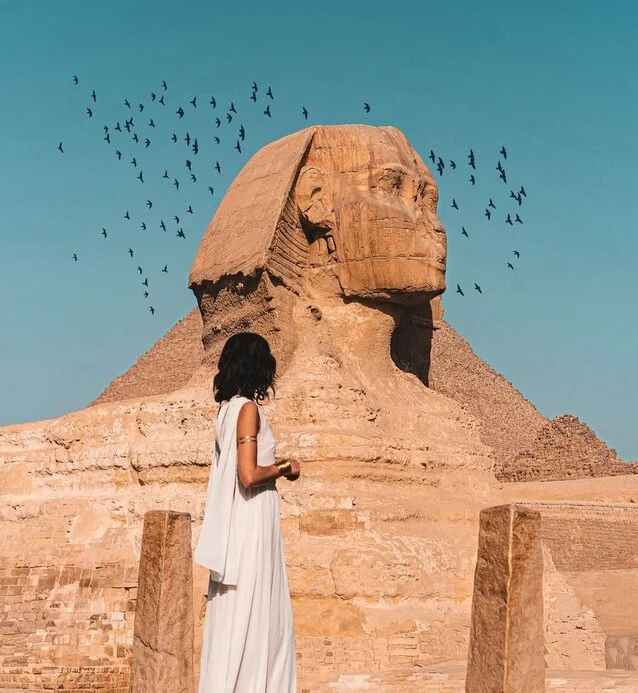
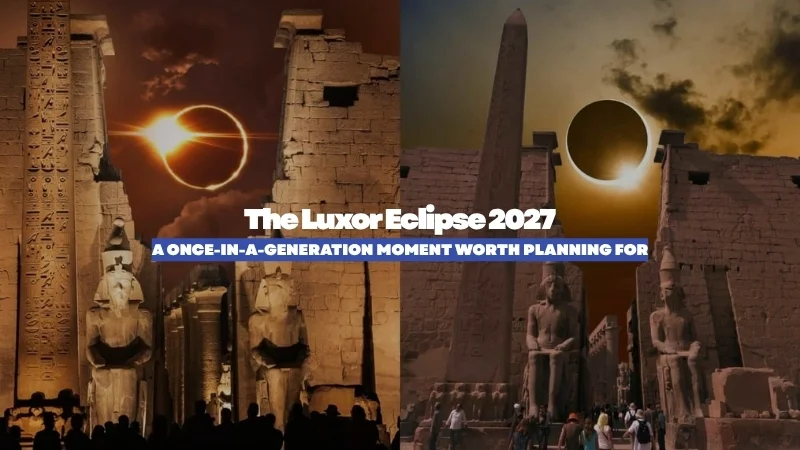
Picture standing in the Nile Valley, surrounded by temples that have witnessed thousands of years of history, as the Moon slowly swallows the Sun until daylight itself switches off at the height of noon. This isn't a scene from a film — it's what will happen over Luxor's skies on August 2, 2027, when the Moon's shadow sweeps across the Nile Valley to give Egypt one of the longest total solar eclipses of the 21st century.
The Luxor Eclipse 2027 will deliver roughly 6 minutes 22–23 seconds of true darkness in broad daylight — a duration that places Luxor among the best land-accessible destinations for a total eclipse for decades to come.
Whether you're an individual traveler planning the trip of a lifetime, a family deciding if this is feasible, a photographer chasing the shot of a career, or a tour operator coordinating a delegation, this guide walks you through everything — from initial planning to the moment you reinstall your solar filters after totality ends — with practical, operational detail rather.
Eclipses of this length are uncommon, and the practical consequence is straightforward: accommodation near the centerline and permitted observation sites are the two things most likely to fill first. Both are covered in detail below.
The Luxor Eclipse 2027 is a total solar eclipse crossing Egypt's Nile Valley on August 2, 2027. The Moon will fully block the Sun for approximately 6 minutes 22–23 seconds near Luxor — one of the longest totality durations of the century — with the Sun sitting almost directly overhead at roughly 82° altitude.
The eclipse occurs on August 2, 2027. In Luxor, the partial phase begins around 11:22 local time (EEST, UTC+2), totality runs from approximately 13:02 to 13:08, and the event ends around 14:48. Maximum eclipse falls at approximately 13:05:16. These figures are current best estimates for the Luxor area. Because eclipse timing is sensitive to exact location, confirm the exact contact times for your observation site closer to the event.
Luxor sits close enough to the eclipse centerline to experience nearly the full duration of totality, making it Egypt's premier viewing destination. The point of greatest eclipse falls about 60 km southeast of the city, in the Eastern Desert. Within the Luxor area, desert and west-bank sites generally offer better sky conditions than the city center, while Luxor itself offers easier access to services and accommodation.
If you're planning to watch from Cairo or Alexandria instead, expect a partial eclipse only — noticeably dimmer daylight, but not the darkness or corona visibility of totality.
Totality at Luxor will last approximately 6 minutes 22–23 seconds, varying slightly depending on exact position relative to the centerline. This is one of the longest totality durations of any total solar eclipse in the 21st century.
Deciding between a city-based or desert-based site comes down to what you're prioritizing — ease of access, or optimal sky conditions. Both options are covered in detail in the site-selection section below.
The path of totality enters Egypt from the northwest near Siwa Oasis. It crosses the Western Desert, runs through the Nile Valley via Luxor and Qena, and exits toward the Red Sea and Saudi Arabia.
Cairo and Alexandria sit entirely outside this path and will see only a partial eclipse. This is one of the most common planning mistakes eclipse travelers make: assuming a Cairo base allows for a short day trip to catch totality. It doesn't. Reaching Luxor requires dedicated travel time, whether by domestic flight or overnight train, and that transfer needs to be built into the itinerary well before August 2. Staying in the capital on eclipse day means missing totality entirely.
Planning a Nile itinerary around the eclipse? The Egypt Travel Guide and Best Time to Visit Egypt resources cover how to sequence Cairo, Luxor, and Aswan into one trip.

Site selection isn't just an aesthetic choice — it directly determines how much of the eclipse you actually get to enjoy versus manage. Four practical factors decide whether your morning is calm or stressful: access to services, crowd density, sky conditions, and permit requirements.
| Criterion | Urban Sites (Luxor city center) | Desert/Rural Sites (west bank, desert margins) |
| Access to services (power, water, medical) | High | Low to none — self-supplied |
| Light pollution (relevant for pre-dawn/post-totality imaging) | Moderate to high | Low |
| Crowd density | High — expect saturation | Variable, controllable via permits |
| Southern horizon clearance | Often obstructed by buildings or palms | Generally unobstructed |
| Night-access restrictions | Minimal | May require security coordination |
| Capacity for tripod/telescope arrays | Constrained | Scalable |
Three factors deserve particular attention when comparing sites.
Southern horizon profile is irrelevant to the eclipse itself given the 82° solar altitude, but it still matters for pre-event calibration imaging or wide-field context shots.
Prevailing wind and dust loading is a real consideration in the Luxor region, which sees seasonal dust suspension. Sites downwind of unpaved roads or agricultural land should be deprioritized for optical work.
Night-access restrictions can affect pre-dawn arrival for full-day calibration, particularly near archaeological zones such as Karnak Temple or the Valley of the Kings, where coordination with local security may be required.
If you're an individual traveler prioritizing comfort and short transfer times, a Luxor-based site with easy access to hotels and services is the practical choice. If you're running a delegation with professional imaging equipment, a desert site gives you better crowd control, darker skies for pre-dawn work, and room to scale your tripod or telescope array — but it also means arranging your own power, water, and medical support. Match the site to what you're actually optimizing for, not to which one photographs better in isolation.
Hotel capacity in Luxor is likely to come under significant pressure well before August 2027. Hotels near the West Bank are expected to fill well before typical high-season booking windows close, because eclipse travelers — unlike standard leisure bookers — tend to commit far earlier than usual. Professional delegations should aim to secure block bookings 12–18 months out; standard leisure booking timelines will not guarantee room allocation this close to a high-demand event.
Licensed field camps and temporary accommodation with baseline services — potable water, sanitation, power — are worth identifying now as a contingency for teams unable to secure hotel rooms.
Cabins on vessels transiting the Luxor–Aswan corridor double as accommodation and mobile observation platforms. Capacity on this route is expected to fill early as well, so a Nile cruise built around eclipse timing is worth evaluating now rather than closer to the date.
Whether you're booking two rooms for your family or block-booking for a delegation, the practical rule is simple: if you're still deciding six months out, your first-choice property near the centerline is already at meaningful risk of being full. Book as soon as your dates are fixed, and treat 12–18 months as the realistic planning window rather than a worst-case estimate.
Planning to visit Luxor for the eclipse?
Explore Kadmar Travel's 2027 Solar Eclipse Package or let our team design a custom itinerary for you.
Site permits are required for any structured setup involving mounted equipment, elevated platforms, or generators — especially near archaeological sites such as the Valley of the Kings or the Karnak Temple precinct.
Traffic and police coordination is essential for any group larger than a single vehicle convoy. Confirm road closures and checkpoint procedures with local traffic authorities in the weeks before the event.
Facility hours should be confirmed with local authorities, since public facilities, fuel stations, and medical points may need to operate extended hours on eclipse day given the expected demand spike.
Permits and coordination aren't paperwork to leave until the week of the event. A rejected or delayed permit on the morning of August 2 means relocating your entire setup with no time to test the new site, so confirming permit status well ahead of travel is worth treating as a priority, not a formality.
Unfiltered solar viewing outside totality risks solar retinopathy — permanent retinal damage that can occur without pain, so comfort is not a reliable safety indicator.
Certified filtration is required for all partial phases, before second contact and after third contact. Filters, whether for direct viewing or camera optics, should meet the ISO 12312-2 international standard for solar observation filters.
Check filter integrity before use. Scratches, punctures, or delamination compromise attenuation and make a filter unsafe. Use full-aperture, front-mounted filters rated specifically for solar imaging — neutral density or polarizing filters not rated for solar use provide insufficient protection.
Naked-eye viewing is safe only during totality, the brief window between second and third contact when the Sun is fully obscured, approximately 6 minutes 22–23 seconds at Luxor. Reinstall filters the moment the diamond ring effect appears at third contact.
Brief the whole team, including non-technical staff and clients, before the event. Filter safety knowledge should not be assumed.

The figures below reflect current published eclipse-circumstance calculations for the Luxor area and should be treated as planning estimates. Only the moment of maximum eclipse is commonly quoted to the second in published sources; contact times are given to the nearest minute. Confirm final second-by-second timings for your specific coordinates closer to the event, since even small positional offsets shift local contact times.
| Stage | Approximate Local Time | Description |
| First contact (C1) | ≈ 11:22 | Partial eclipse begins |
| Second contact (C2) | ≈ 13:02 | Totality begins; safe to remove solar filters |
| Maximum eclipse | ≈ 13:05:16 | Greatest coverage; Sun at ≈82° altitude |
| Third contact (C3) | ≈ 13:08 | Totality ends; diamond ring effect; reinstall filters immediately |
| Fourth contact (C4) | ≈ 14:48 | Partial eclipse ends |
Total duration of totality at Luxor: approximately 6 minutes 22–23 seconds, varying slightly with exact position relative to the centerline.
Synchronize imaging systems to a common time reference — GPS clock or NTP — in the days before the event, with a final check on the morning of August 2. This matters most for teams running multi-camera sequences or assembling timestamped frames into a composite corona image.
| Phase | Aperture | ISO | Shutter Speed (starting point) | Notes |
| Partial phases (filtered) | f/8–f/11 | 100–200 | 1/500–1/1000s | Filter-dependent; test in advance |
| Diamond ring / Baily's beads | f/8–f/11 | 100–400 | 1/1000–1/4000s | Very brief — bracket aggressively |
| Inner corona | f/8–f/11 | 100–400 | 1/500–1/1000s | Unfiltered |
| Mid corona | f/8–f/11 | 200–400 | 1/60–1/125s | Unfiltered |
| Outer corona | f/8–f/11 | 400–800 | 1/4–1/15s | Unfiltered; a tracking mount helps avoid trailing |
A bracketed multi-exposure sequence across several stops supports HDR compositing of the corona in post-processing, given the wide dynamic range between its inner and outer regions.
A professional-grade itinerary needs a pre-confirmed observation site with documented capacity and permit status, clear equipment logistics terms defining what is client-supplied versus operator-supplied, on-site technical personnel such as a mount technician or imaging support staff, and flexible time windows that allow short-notice site relocation if weather demands it.
Support for this kind of event generally falls into three tiers: basic support covering site information, timing data, and general observation guidance; technical support adding certified filters, tripods, specified equipment, and on-call technical assistance; and full logistics, which includes dedicated transport, licensed field camp infrastructure, and a full crowd-management team.
Contract terms matter as much as the itinerary itself. Look for documented provider responsibilities at each service tier, a clear cancellation or rebooking policy for weather-related changes or authority-imposed restrictions, and explicit safety obligations, including certified filtration and a pre-event safety briefing. If you're a tour operator, these terms determine what happens to your business if conditions change at the last minute — ask any prospective logistics partner for their cancellation and rebooking terms in writing before you sign. If you're an individual traveler booking through an operator, ask the same question: what happens to your booking if the observation site is relocated the morning of the event?
A useful test for deciding how much support you need: if your group is under ten people, comfortable arranging its own transport and permits, and flexible on site choice, independent planning is realistic. If you're coordinating a larger group, professional equipment, or a fixed schedule that can't absorb a last-minute site change, the coordination overhead usually justifies bringing in dedicated logistics support.
Upper Egypt in early August has a well-established pattern of low cloud cover and negligible rainfall, which is a major reason the region is favored for eclipse observation. This is worth a final check against current seasonal forecasts as the event approaches. The primary environmental risk here is not rain; it is atmospheric particulate loading.
| Risk Factor | Operational Impact | Mitigation |
| Dust/haze events | Reduced contrast for corona imaging; equipment ingress risk | Monitor short-range forecasts; choose sites with natural windbreaks |
| High wind | Tripod/mount instability, dust mobilization | Sandbag ballast, windbreak positioning, lower-profile rigging |
| Extreme heat (August highs commonly exceed 40°C) | Equipment thermal stress, personnel heat risk | Shade structures, hydration protocols, battery thermal management |
Identify at least one alternate observation site within a short transfer distance of the primary one, ideally still on or near the centerline, for last-minute relocation if dust or cloud develops locally. Set a firm decision deadline — for example, two hours before first contact — for triggering a relocation, based on real-time local conditions and short-range forecasts. Build rebooking flexibility into transport and accommodation contracts so a late change doesn't carry prohibitive cost.
Locals in Luxor structure their day around the August heat, shifting activity to early morning and evening. Eclipse-day scheduling should do the same: front-load equipment setup and testing before 9am, and treat the late-morning to early-afternoon window as heat-management time as much as observation time. Shade, hydration, and battery protection matter as much here as camera settings do.
Documentation and permits
Valid travel documents and any required site-access permits
Confirmed accommodation and transport reservations, including fallback options
Core equipment
ISO 12312-2 certified solar filters (visual and imaging, with spares)
Tripod/mount rated for expected wind conditions
Backup lens/optics and backup camera body, if available
Generator or sufficient power banks for the full day
Communications and navigation
Handheld radio or alternative communication method (expect mobile network congestion)
GPS device or offline map of the site and transport routes
Portable power banks for communication devices
Timing and site logistics
A detailed eclipse-day schedule with stage timings for your specific coordinates
Confirmed rally point and transport pickup time
Time-synchronization check completed the morning of the event
Contingency and safety
Weather contingency plan with a named fallback site
Filter safety briefing completed with the full team
Emergency assembly point and evacuation route confirmed with all attendees

The astronomical event ends at fourth contact around 14:48, but your day in Luxor shouldn't end there. As the sun gradually dips after the hot afternoon, the city begins to exhale — and this is the perfect time to experience Luxor from an angle entirely different from your scientific observation setup.
Consider closing out your day with a quiet Nile sunset cruise, as the slanting light turns the water into shades of gold — a beautiful contrast after hours spent focused on the Sun through a lens or a filter. Or dedicate the evening to Karnak Temple's sound-and-light show, where the massive columns tell thousands of years of stories under lighting that creates an entirely different atmosphere from the day's heat.
If you prefer a slower pace, a small café on the Nile Corniche, with the evening breeze finally settling in after a hot day, gives you a chance to review your photos and talk through an experience that won't come around again soon.
The eclipse may be the reason for your trip, but the Corniche at sunset, the temple lit up at night, and the quiet cafés along the river are what will stay with you afterward. Explore Luxor Tours and Aswan Tours for ways to extend your trip before or after August 2.
Planning for the 2027 Total Solar Eclipse in Luxor requires much more than booking flights and a hotel. Accommodation, transportation, eclipse viewing logistics, site access, and certified observation equipment all need to be arranged well in advance, as demand is expected to be exceptionally high and availability will become increasingly limited as the event approaches.
If you'd rather leave the planning to local experts, you can join Kadmar Travel's Egypt Solar Eclipse: Luxor 2027 Trip—a carefully designed package that combines premium eclipse viewing with accommodation, transportation, guided sightseeing, and on-the-ground support throughout your journey.
Looking for something more personalized? Kadmar Travel can also design a custom eclipse itinerary tailored to your interests, travel dates, budget, and group size. Whether you're traveling independently, with family, or organizing a larger delegation, our team can create a bespoke experience that includes your preferred hotels, private transfers, sightseeing, and eclipse-day logistics—allowing you to focus on enjoying one of the most remarkable astronomical events of the century.
Whichever option you choose, booking early is the best way to secure your preferred accommodation, transportation, and viewing arrangements before availability becomes limited.
FAQ
Can standard eclipse glasses be used during the partial phases?
Yes, provided they meet the ISO 12312-2 safety standard and show no scratches, punctures, or delamination. They're required for both partial phases — before second contact and after third contact. Unfiltered viewing is safe only during totality itself (approximately 6 minutes 22–23 seconds at Luxor), and filters need to go back on the instant the diamond ring effect appears at third contact.
How do I time my shots precisely enough to catch the exact moment of totality?
Synchronize your camera systems to a GPS-disciplined clock or an NTP time source in the days beforehand, then perform a final check on the morning of August 2. Paired with a pre-programmed intervalometer sequence and bracketed exposures around the predicted contact times, this significantly reduces the risk of missing the window due to clock drift.
What actually determines a good observation site for a professional photographer?
Horizon clearance suited to the framing plan, prevailing wind and seasonal dust direction, proximity to logistical support (power, transport, medical), ease of pre-dawn access, and enough separation from general public crowd flow to work without interference. Sites on or near the centerline maximize totality duration, but that has to be weighed against accessibility and infrastructure trade-offs.
Will Luxor hotels sell out?
Given the length of totality and Luxor's accessibility, demand is expected to be high well before 2027. Block bookings 12–18 months out are recommended for groups; individual travelers should also book earlier than they would for a typical trip.
Is Luxor too hot in August?
August highs in Luxor commonly exceed 40°C. It's manageable with planning — hydration, shade during midday hours, and scheduling around the heat — but it's a real operational factor, not a minor inconvenience, especially for groups spending hours at an observation site.
Can children safely watch the eclipse?
Yes, with the same precautions that apply to adults: ISO 12312-2 certified eyewear during all partial phases, direct supervision, and a clear briefing beforehand so children understand when it is and isn't safe to look up without filters.
Is a Nile cruise a good viewing platform?
It can be, particularly for the Luxor–Aswan corridor, since a river-based platform avoids some of the ground congestion expected on eclipse day. Confirm the vessel's exact position relative to the centerline, as duration of totality shifts with location.
What happens if there is dust on eclipse day?
Dust and haze are the primary weather risk in this region during early August, more so than rain. Sites with natural windbreaks reduce exposure, and having a fallback site identified in advance — ideally still near the centerline — is the main practical mitigation.
Can I photograph the eclipse with a smartphone?
Yes, though results are limited compared to dedicated optics. Use a certified solar filter over the lens for partial phases, and a stable mount to avoid blur during totality. Many phones handle wide context shots — the darkened sky, the crowd — better than close-up disk shots.
How early should I arrive at my observation site?
Arrive well before first contact — several hours for group or professional setups — to allow for equipment testing, dust and wind assessment, and calibration imaging. Staggered arrival from pre-dawn through mid-morning also helps avoid a single congestion spike.
Is travel insurance recommended?
Yes. Given the scale of expected demand on accommodation, transport, and site access, insurance that covers trip disruption and cancellation is a reasonable safeguard, particularly for delegations with non-refundable bookings.
Can I watch from Karnak Temple?
Structured setups involving mounted equipment, elevated platforms, or generators near Karnak Temple require site permits, given its status as an archaeological zone. Confirm access and equipment restrictions with local authorities well in advance.
Which camera lens works best?
A telephoto lens or telescope in the 400–2000mm equivalent range produces disk-filling frames of the eclipsed Sun. A wide lens is also worth carrying for context shots — the darkened sky, the horizon, the crowd — which a long lens can't capture.
References
Ready to embark on your Egyptian adventure? Contact Kadmar Travel today and let us turn your travel dreams into reality.
Reach out to our dedicated team at Inbound@kadmartravel.com or call us at +2034839726
Reach out to our dedicated team at Inbound@kadmartravel.com, call us at +2034839726, or contact us through WhatsApp at +201286739037.
Don't just visit Egypt; experience it with Kadmar Travel
Or fill out the form below and we will call you back for any information needed.