
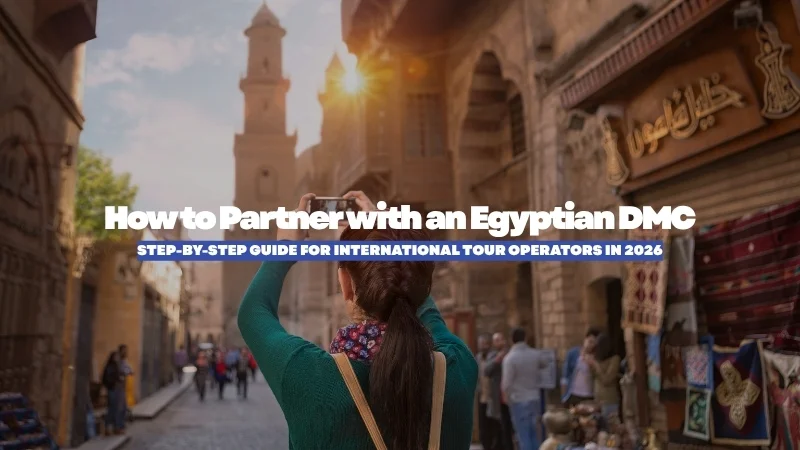
Beyond competitive pricing, international tour operators face increasing complexity when selecting the right partner in Egypt. Understanding how an Incoming Tour Operator in Egypt manages ground operations, hotel allotments, transportation logistics, and destination services is essential before entering any agreement.
At the same time, buyers must evaluate how German tour operators select an Egyptian DMC in 2026 based on compliance standards, digital capabilities, sustainability practices, and service-level commitments. With these fundamentals in place, operators can confidently build a structured and scalable long-term partnership.
Today's tourism environment requires much more than hotel bookings and airport transfers. International tour operators need local partners capable of delivering:
Operational reliability across Egypt
Real-time reservation management
Strong supplier networks
Crisis response capabilities
Compliance with European quality standards
Sustainable tourism practices
A professional Egyptian DMC becomes an extension of your own operations team, helping you manage customer experiences while reducing operational risk.
Before discussing pricing or contracts, perform a comprehensive evaluation of the DMC's credentials.
Request documentation including:
Commercial registration
Tourism operating licenses
Tax registration certificates
Insurance coverage documentation
Memberships in tourism associations
A legitimate DMC should be able to provide these documents quickly and transparently.
Financial strength is critical for long-term cooperation.
Evaluate:
Years in operation
Market reputation
Banking references
Supplier relationships
Ability to manage large seasonal allotments
A financially stable partner is less likely to encounter operational disruptions during peak seasons.
Gather independent feedback from:
Existing international partners
Hotel partners
Transportation providers
Industry associations
Online B2B networks
Strong references often indicate consistent service quality and operational maturity.

Once the initial due diligence is completed, assess whether the DMC can support your specific business model.
A capable Egyptian DMC should demonstrate expertise in:
Ensure the company can manage:
Individual travelers
Large groups
VIP arrivals
Incentive programs
Last-minute schedule changes
Review:
Fleet quality and maintenance standards
Vehicle categories available
Safety certifications
GPS monitoring systems
Driver training procedures
Verify operational capabilities across major destinations such as:
Cairo
Luxor
Aswan
Hurghada
Sharm El Sheikh
Alexandria
Marsa Alam
Consistent service quality across destinations is a key indicator of operational strength.
Hotel contracting remains one of the most important competitive advantages of any DMC.
Evaluate:
Direct hotel agreements
Allotment availability
Dynamic pricing capabilities
Seasonal inventory management
Luxury and niche product access
The strength of a DMC's hotel network directly affects your pricing competitiveness.
In 2026, technology is no longer optional.
Ask about:
Online reservation systems
XML/API connectivity
Real-time availability management
Automated confirmations
Reporting dashboards
Data security standards
A modern DMC should support efficient digital collaboration rather than relying solely on manual email workflows.

After selecting a preferred partner, establish measurable service standards.
Define expected response times for:
Clear expectations reduce misunderstandings and improve accountability.
KPIs may include:
Booking accuracy rate
Hotel confirmation accuracy
Transfer punctuality
Complaint resolution time
Customer satisfaction scores
Emergency response effectiveness
Performance metrics should be reviewed regularly.
Every agreement should include protocols for:
Flight disruptions
Hotel overbookings
Transportation breakdowns
Medical emergencies
Force majeure situations
Strong crisis-management procedures protect both the operator and the end traveler.

A successful partnership requires transparent commercial terms.
Clarify:
Net rates
Commission models
Markup policies
Seasonal pricing
Group pricing structures
Avoid ambiguity in commercial arrangements.
Establish:
Deposit requirements
Credit periods
Currency terms
Refund procedures
Financial guarantees
Clear payment policies help maintain healthy long-term relationships.
Contracts should define:
Free cancellation periods
Partial refund schedules
Force majeure conditions
Supplier-specific penalties
The more detailed the policy, the fewer disputes will occur later.

Many operators make the mistake of scaling immediately after signing a contract.
A pilot phase allows both parties to validate operational readiness.
Start with:
Small leisure groups
Limited departures
Selected destinations
Controlled service scope
This approach helps identify operational gaps before major commitments.
Track:
Response speed
Service consistency
Supplier coordination
Guest feedback
Internal communication quality
Use findings to optimize workflows before expanding volumes.

Long-term success depends on operational alignment.
Assign dedicated contacts for:
Sales
Reservations
Operations
Contracting
Emergency support
Defined responsibilities eliminate confusion.
Where possible, connect systems through:
API integrations
Shared booking platforms
Automated reporting tools
Inventory synchronization
Technology improves efficiency and reduces manual errors.

The strongest DMC relationships evolve beyond transactional supplier arrangements.
Focus on:
Joint product development
Destination expansion
Sustainability initiatives
Market intelligence sharing
Annual business reviews
Continuous service improvement
A strategic partnership creates mutual growth opportunities and stronger market positioning.
Many international operators encounter challenges because they:
Select partners solely on price
Skip formal due diligence
Ignore technology readiness
Fail to establish SLAs
Scale operations too quickly
Lack emergency response protocols
Neglect regular performance reviews
Avoiding these mistakes significantly improves partnership success rates.
Building a successful partnership with an Egyptian DMC requires more than signing a contract—it depends on understanding operational capabilities, compliance standards, and long-term strategic alignment.
To deepen your understanding of the local tourism ecosystem, learn how German tour operators evaluate and select Egyptian DMC partners in 2026. Together, these insights provide a complete framework for selecting the right destination management company in Egypt and building sustainable, long-term growth in the market.
Ready to build a reliable and scalable partnership in Egypt?
Work with Kadmar Travel to access experienced destination management professionals, strong supplier networks, advanced operational capabilities, and technology-driven B2B solutions designed for international tour operators.
Request a proposal today or contact our B2B team to start designing your Egypt programs with a trusted local DMC partner.
The first step is conducting a comprehensive due diligence process that verifies legal licensing, financial stability, operational capacity, and market reputation.
SLAs establish measurable service expectations, response times, accountability standards, and crisis-management procedures that protect both parties.
API connectivity provides real-time access to inventory, pricing, availability, and booking confirmations, enabling faster and more efficient operations.
Most operators run pilot operations for one season or a limited number of departures before expanding cooperation to larger programs.
Ready to embark on your Egyptian adventure? Contact Kadmar Travel today and let us turn your travel dreams into reality.
Reach out to our dedicated team at Inbound@kadmartravel.com or call us at +2034839726
Reach out to our dedicated team at Inbound@kadmartravel.com, call us at +2034839726, or contact us through WhatsApp at +201286739037.
Don't just visit Egypt; experience it with Kadmar Travel
Or fill out the form below and we will call you back for any information needed.