For most first-time visitors, two full days in Luxor are ideal. This gives you one day to explore the West Bank’s royal tombs and mortuary temples, and another for Karnak Temple, Luxor Temple and the city’s museums. One day is enough for a highlights-focused visit, while three or four days allow time for lesser-visited monuments, a sunrise hot-air balloon flight and a more relaxed pace.
The best length of stay depends on your interests, arrival time and onward travel plans. Rather than trying to fit every monument into your schedule, group nearby sites together and leave enough time to appreciate them.
How Many Days Do You Need in Luxor?
| Time in Luxor | What It Covers | Pace | Ideal For |
| 1 day | Valley of the Kings, Hatshepsut’s Temple, Karnak and Luxor Temple, subject to time | Fast; limited flexibility | Travelers connecting Luxor with another destination |
| 2 days | The principal West Bank and East Bank monuments on separate days | Balanced but active | First-time visitors |
| 3 days | Major monuments, additional tombs, Medinet Habu, museums or a balloon flight | Relaxed and flexible | Couples, families and history enthusiasts |
| 4+ days | Archaeological sites beyond the highlights, cultural experiences and unhurried exploration | Slow travel | Repeat visitors, photographers and serious Egyptology enthusiasts |
Our recommendation: Plan for two full sightseeing days if this is your first visit. Choose three days if you want to explore beyond the main monuments or include a hot-air balloon flight without making the rest of your itinerary too demanding.
Keep in mind that two hotel nights do not necessarily give you two full sightseeing days. If you arrive late in the afternoon and leave early the following morning, you may have time for only one substantial day of sightseeing.
The most practical approach is to dedicate one day to the West Bank and another to the East Bank. This reduces unnecessary travel between sites and gives you more time to explore.
Start early, particularly during the warmer months. The West Bank's archaeological sites are spread across an exposed landscape, and several of the most important monuments offer limited shade.
Begin at the Valley of the Kings, the royal burial ground where pharaohs of the New Kingdom were laid to rest. Inside the tombs, painted walls, astronomical ceilings and funerary scenes reveal aspects of ancient Egyptian beliefs about death and the afterlife.
Standard admission generally covers three tombs selected from those open to visitors. Some famous tombs, including Tutankhamun and Seti I, require separate tickets. Ramesses V and VI is another popular option with additional admission arrangements.
Choose your tombs according to your interests rather than trying to visit as many as possible. If you particularly enjoy ancient Egyptian art, allow enough time to examine the wall paintings and inscriptions.
Allow approximately two to three hours as a planning guide, adjusting for queues, the tombs available that day and any additional tickets you choose to purchase.
Continue to the mortuary temple of Queen Hatshepsut at Deir el-Bahri. Its broad terraces, colonnades and monumental setting beneath the limestone cliffs make it one of Luxor's most distinctive landmarks.
Walk through the different levels to appreciate the architecture and surviving reliefs. Visiting earlier in the day can also make the outdoor sections more comfortable, particularly in hot weather.
Stop at the Colossi of Memnon, two monumental seated statues associated with the mortuary temple of Amenhotep III.
This is a relatively short visit and fits naturally into a route that includes the Valley of the Kings and Hatshepsut's Temple.
After lunch, decide whether you want to explore another archaeological site or return to your hotel.
Medinet Habu, the mortuary temple of Ramesses III, is a worthwhile addition for visitors interested in monumental architecture and detailed reliefs. Alternatively, keep the afternoon free to rest before dinner.
Trying to include every major West Bank site in one day can make the experience unnecessarily tiring. Choose the additional stops that genuinely interest you.
A hot-air balloon flight offers a different perspective on Luxor, with views across the Nile, agricultural land and the surrounding archaeological landscape.
However, it requires a separate pre-dawn start, with pickup times often around 4:00–4:30 AM depending on the operator and season. You will need to allow for the flight, landing, transfers and breakfast before beginning your archaeological visits.
Combining a balloon flight with the West Bank's main monuments is possible, but it makes for a long morning. Flights are weather-dependent and may be cancelled for safety reasons, so avoid scheduling a tightly timed onward transfer immediately afterwards.
Keep your evening flexible. Enjoy dinner near the river, take a walk along the Corniche or return to your hotel for an early night before exploring the East Bank.
The East Bank combines vast temple complexes with museums and the modern city. Start with Karnak, take a break during the middle of the day, then visit Luxor Temple later in the afternoon or evening.
Allow around two to three hours for Karnak if you want to explore beyond its most famous features.
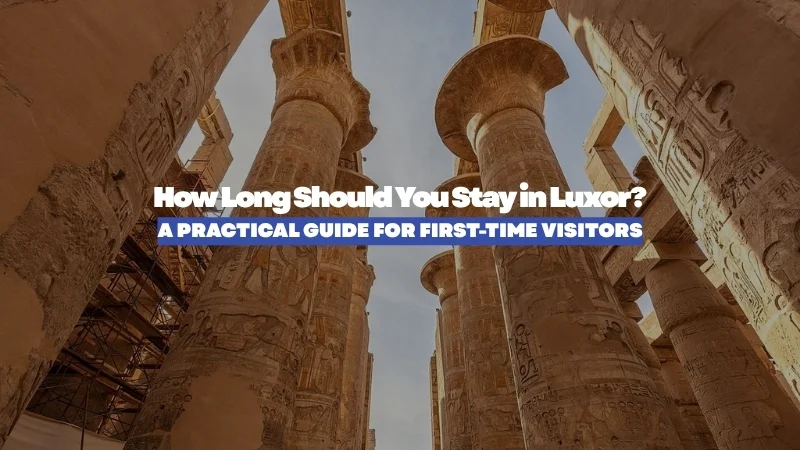
The complex developed over many centuries and contains monumental gateways, obelisks, sacred spaces and the celebrated Great Hypostyle Hall, whose enormous columns are among the site's most recognisable features.
Take your time walking through the complex. Its scale is easy to underestimate, and rushing between the main landmarks can mean missing architectural details and less crowded sections.
Morning is generally a sensible time to visit, particularly when temperatures are high. Check the current opening hours before deciding on your exact arrival time.
Return towards central Luxor for lunch and some time out of the sun.
If you are visiting during a hot period, a proper break is more useful than squeezing another outdoor attraction into the middle of the day.
Luxor Museum offers a more focused experience after the monumental scale of Karnak. Its collection includes archaeological objects and works of art that help put the temples and royal tombs into context.
Allow around one to two hours, depending on your interest in the collection. If museums are not a priority, use the afternoon to rest or explore the city at your own pace.
Save Luxor Temple for later in the day, when the changing light creates a different atmosphere around its columns, statues and monumental walls.
Unlike Karnak, the temple stands within the modern city, making it easy to combine with an evening walk or dinner. Check the current visiting hours before planning your arrival.
If time allows, explore the Avenue of Sphinxes, the historic ceremonial route linking the areas of Karnak and Luxor Temple.
With two full days, you can experience Luxor's principal monuments without having to rush through every stop. If you want additional tombs, quieter archaeological sites or more time for photography, consider staying another night.
An extra day gives you the flexibility to explore beyond the best-known monuments. Rather than adding attractions simply to fill your schedule, choose sites that match your interests.
Visit the mortuary temple of Ramesses III, known for its substantial surviving architecture and detailed carved reliefs.
It is particularly worthwhile for travellers who want to explore royal monuments beyond the Valley of the Kings and Hatshepsut's Temple.
The Valley of the Queens contains tombs associated with royal women and children. Its quieter atmosphere and decorated burial chambers offer a different perspective on royal funerary traditions.
Some tombs require separate admission, so check the current ticket arrangements if you have a particular tomb in mind.
Deir el-Medina preserves the remains of the settlement where artisans and workers involved in constructing royal tombs lived. The site adds a human dimension to the monumental architecture found elsewhere on the West Bank.
Afterwards, return to your hotel, revisit a favourite site if permitted by your ticket arrangements, or enjoy a relaxed afternoon.
A fourth day allows you to experience Luxor without a fixed sightseeing schedule.
Consider these options:
Spend more time at Karnak: Revisit the complex with a particular interest in its architecture, inscriptions or photography.
Explore Luxor Museum: Give the collection more time instead of fitting it between temple visits.
Take a sunset felucca sail: Enjoy views of the river, agricultural banks and changing light. Departure times depend on local conditions and the operator.
Discover the city at your own pace: Visit cafés, browse local shops or enjoy a longer lunch without worrying about your next transfer.
Travellers with a strong interest in archaeology can easily find more sites to explore. You do not need to visit all of them, however; a carefully chosen itinerary is often more rewarding than a packed schedule.

The Valley of the Kings, Hatshepsut's Temple and other archaeological sites are spread across the West Bank, so allow time for transfers between them.
An early start can help you avoid some of the midday heat and may provide a quieter experience before larger tour groups arrive. Opening hours vary, however, so treat an early departure as a planning strategy rather than a guarantee that every site will be accessible at a particular time.
Standard admission generally covers three tombs selected from those open under the standard ticket. Entry to certain famous tombs requires an additional ticket.
These include:
Tutankhamun (KV62): Best known for the discovery of its largely intact royal burial assemblage.
Seti I (KV17): Noted for its extensive decoration and richly painted chambers.
Ramesses V and VI (KV9): Recognised for the astronomical and funerary texts decorating its ceilings and walls.
Check the official ticket arrangements, prices and tomb availability before your visit, as these details can change.
Payment arrangements may also vary. Carry a working bank card as well as some cash for incidental expenses, and verify the accepted payment methods for archaeological tickets before travelling.
Karnak is best approached as a substantial morning visit, when you can explore its extensive grounds before the hottest part of the day.
Luxor Temple works well later in the afternoon or evening, when the light changes and the illuminated architecture creates a different atmosphere.
This arrangement also helps divide the East Bank into a manageable day rather than trying to fit both temples into a rushed visit.
A hot-air balloon excursion usually starts before sunrise. Exact pickup and flight times depend on the operator, season and weather.
If the flight is a priority, allow flexibility for transfers, landing and breakfast. Avoid combining it with a tightly timed departure or an itinerary that leaves no room for delays.
For Luxor's archaeological sites, bring:
Comfortable walking shoes.
A hat, sunglasses and high-protection sunscreen.
Drinking water appropriate to your route and the day's conditions.
A charged phone or camera and a power bank.
A bank card and some cash for incidental expenses.
Photography rules vary by site, ticket and location. Check signs and follow local instructions, particularly inside tombs.
The West Bank's monuments are spread across several locations. Group nearby sites together to reduce unnecessary driving and waiting time.
A private vehicle can be useful if you want to combine the Valley of the Kings, Hatshepsut's Temple and additional monuments in one day. Independent taxis and local transport may suit simpler routes, depending on where you stay.
If you are crossing between the East and West Banks, account for the transfer when planning your schedule.

Your accommodation affects how easily you can reach the monuments, where you spend your evenings and how much flexibility you have during the day.
The East Bank is a practical base for a short stay, particularly if you want restaurants, cafés, transport and the city's main services nearby.
Choose the East Bank if you want:
Convenient access to Karnak and Luxor Temple.
A choice of restaurants and cafés.
An easy base for a two-day itinerary.
More options for evening walks and dining.
For most first-time visitors with limited time, it is a straightforward option.
The West Bank may suit travellers who prefer a quieter setting and want to spend several mornings exploring the royal tombs and mortuary temples.
It can offer:
Convenient access to archaeological sites on that side of the river.
A quieter atmosphere away from the city centre.
A suitable base for a multi-day archaeology-focused itinerary.
More flexibility for early departures to nearby monuments.
Check the exact location of your accommodation before booking. Properties described as being in Luxor can be some distance from the sites you plan to visit.
A Nile cruise suits travellers who want Luxor to form part of a wider journey through southern Egypt. Instead of staying in one city and arranging every excursion independently, you travel along the river and visit major sites according to the vessel's schedule.
A cruise can provide:
A coordinated itinerary linking Luxor and Aswan.
Accommodation and meals aboard the vessel.
Excursions to destinations such as Edfu and Kom Ombo, depending on the route.
Time to relax between sightseeing stops.
The trade-off is flexibility. Cruise excursions follow a schedule, and a short stop in Luxor may not allow enough time for every additional tomb or monument.

A dahabiya is a smaller, traditional-style sailing vessel that can offer a more intimate river journey than a large cruise ship. It may appeal to couples and travellers who prefer a quieter atmosphere, although facilities, routes and sailing arrangements vary.
It is not necessarily the best choice if your main goal is to spend several days exploring Luxor's archaeological sites. A hotel stay provides more freedom, while a dahabiya makes sense when the river journey itself is an important part of your holiday.
The simplest way to decide: Stay in a hotel if you want to explore Luxor in depth. Choose a Nile cruise if you want to combine Luxor with a broader journey between Aswan and other historic sites along the river.
The right itinerary depends on where you are arriving from, how much time you have and whether you prefer hotel stays, private transport or a Nile cruise. These Kadmar Travel options offer different ways to organise your Egypt holiday.
Combine Cairo's major attractions with a three-night Nile cruise between Aswan and Luxor. This seven-day, six-night itinerary brings together Egypt's major destinations, guided sightseeing and time aboard the vessel.
Best for: First-time visitors who want to combine Cairo and a Nile cruise in one coordinated itinerary.
Explore the Cairo and Nile Cruise itinerary.
Explore Cairo, Aswan and Luxor with hotel stays and guided sightseeing. The land-based itinerary is an alternative for travellers who prefer to stay in hotels rather than spend the southern portion of their trip aboard a cruise.
Best for: Travellers who want to explore several Egyptian destinations while keeping their accommodation on land.
Explore Timeless Egypt by Land.
If you have limited time in Egypt, ask Kadmar Travel about arranging a private excursion to Luxor from Cairo.
Because flights, transfers and archaeological visits must fit within a limited schedule, confirm the transport arrangements, included sites and available sightseeing time before booking.
Best for: Travellers with a fixed Cairo base who want to prioritise Luxor's principal monuments in a compressed itinerary.
Explore Luxor Tour Packages with Kadmar Travel
If you need a more personalised itinerary, share your travel dates, available nights, preferred accommodation and the monuments you most want to see. Kadmar Travel can help you compare a hotel-based stay, a private land itinerary and a Nile cruise.
One day is enough for a highlights-focused visit if you start early and keep the itinerary selective. You may be able to visit the Valley of the Kings, Hatshepsut's Temple, Karnak and Luxor Temple, depending on opening hours, transfers and how much time you spend at each site. Two full days provide a more balanced experience.
Yes. Two full days are enough for most first-time visitors to explore Luxor's principal monuments. Spend the first day on the West Bank and the second at Karnak, Luxor Temple and, if time allows, Luxor Museum.
Three days are worthwhile if you want to visit Medinet Habu, the Valley of the Queens or Deir el-Medina, spend longer inside the tombs or include a hot-air balloon flight. An extra day also gives you more flexibility during hot weather.
The East Bank is convenient for restaurants, city services, Karnak and Luxor Temple. The West Bank is better suited to travellers who want a quieter base closer to the royal tombs and mortuary temples. Compare the location of each property with your planned sightseeing route before booking.
Neither option is better for every traveller. A hotel stay gives you more freedom to explore Luxor at your own pace and visit lesser-known sites. A Nile cruise connects Luxor with other destinations along the river on a scheduled itinerary. Choose according to whether you want to concentrate on Luxor or experience a broader journey through southern Egypt.
The cooler months, particularly from autumn through early spring, are generally more comfortable for walking around Luxor's outdoor archaeological sites. Daytime temperatures can become very high in summer, making early starts, shade and breaks especially important. Check the forecast before travelling and plan outdoor visits around the conditions.
Two full days are the best starting point for most first-time visitors to Luxor. Spend one day exploring the West Bank's royal tombs and mortuary temples, then dedicate the next to Karnak, Luxor Temple and the city's museums. Add a third or fourth day if you want to explore beyond the main circuit or travel at a slower pace.
Contact Kadmar Travel to plan your Luxor stay around your schedule, interests and preferred way of exploring Egypt.
Ready to embark on your Egyptian adventure? Contact Kadmar Travel today and let us turn your travel dreams into reality.
Reach out to our dedicated team at Inbound@kadmartravel.com or call us at +2034839726
Reach out to our dedicated team at Inbound@kadmartravel.com, call us at +2034839726, or contact us through WhatsApp at +201286739037.
Don't just visit Egypt; experience it with Kadmar Travel
Or fill out the form below and we will call you back for any information needed.