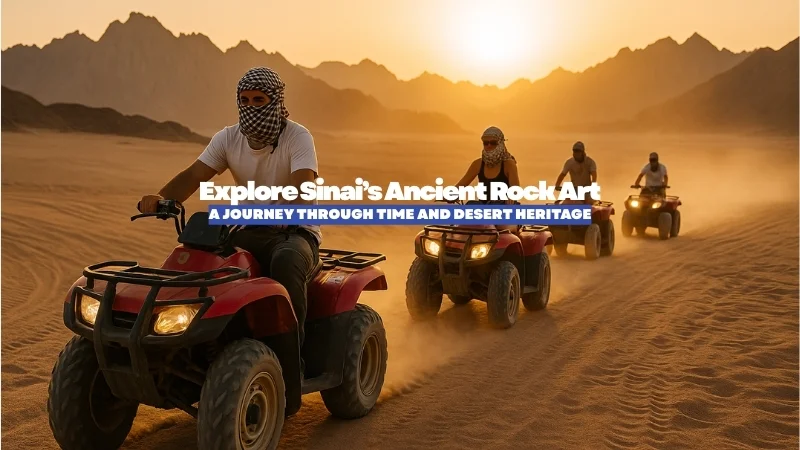
Hidden among the rugged mountains and silent valleys of the Sinai Peninsula lies one of the Middle East’s most remarkable open-air museums. Across its vast desert landscapes, thousands of rock carvings and paintings preserve the voices of travelers, hunters, traders, and pilgrims who crossed these lands over the last 10,000 years.
From prehistoric depictions of animals to inscriptions left by Nabataean traders and early pilgrims, Sinai’s rock art reveals a fascinating story of human movement, survival, and creativity. For history enthusiasts, adventure travelers, and cultural explorers, visiting these ancient sites offers a rare opportunity to walk through a living archive of desert history.
One of Sinai’s most fascinating archaeological landscapes is the Umm Arak Plateau, where visitors can discover rock engravings and paintings dating back thousands of years.
These carvings depict animals, hunters, and symbolic patterns believed to originate from Neolithic communities that once inhabited the region. Walking across the plateau feels like exploring an ancient gallery carved directly into the desert.
Many travelers visit the site with local Bedouin guides who share oral histories and insights about the landscape and its cultural significance.
Why Visit
Discover rock art spanning thousands of years
Experience untouched desert scenery
Learn local traditions from Bedouin guides
Nestled among dramatic desert valleys, Wadi Nasib is known for its mix of prehistoric pictographs and inscriptions from Egypt’s New Kingdom.
The valley once lay along ancient desert routes used by miners and traders traveling between Sinai’s copper and turquoise mines and cities in the Nile Valley. Today, it offers a stunning landscape for hiking, photography, and exploring traces of ancient desert life.
For a full itinerary combining rock art exploration with adventure activities, check out Top Things to Do in Sinai 2026: Red Sea, Diving & Desert.
Perhaps the most famous inscription site in Sinai is Wadi Mukattab, whose name literally means “Valley of Writing.”
Along its sandstone cliffs, visitors can find hundreds of inscriptions left by travelers between the 1st century BCE and the early Islamic period. These include Nabataean, Greek, and early Arabic writings describing journeys, trade, and pilgrimage.
The valley lies along historic routes leading toward the famous Saint Catherine Monastery, making it part of one of Sinai’s most important cultural landscapes.
Travelers entering Sinai should be aware of the new 2026 Sinai-Only Visa Rules. These regulations define how tourists can explore the peninsula, the duration of stay, and entry points, which is essential for planning your desert and cultural adventures safely and legally.

Beyond the well-known sites, many lesser-known valleys in the Sinai Peninsula preserve fascinating rock carvings rarely seen by tourists.
A historic mining valley where ancient Egyptian expeditions once extracted turquoise. The cliffs contain Pharaonic inscriptions and carvings commemorating royal mining missions.
One of Sinai’s most significant archaeological sites. It contains ancient mining inscriptions and some of the earliest alphabetic writing connected to workers who served the temple of Hathor.
The largest oasis in Sinai, surrounded by mountains that hold rock engravings created by travelers and pastoral communities over centuries.
A wide desert valley that served as a caravan route for traders and pilgrims. Several rock carvings and inscriptions remain scattered along its rocky slopes.
Located in the mountainous region near Saint Catherine, this valley contains simple carvings left by shepherds and travelers moving through Sinai’s highlands.
The cultural experience of Sinai would not be complete without the knowledge and hospitality of its Bedouin communities.
For generations, Bedouin tribes have navigated Sinai’s mountains, deserts, and hidden valleys. Many rock art sites can only be reached with local guides who understand the terrain and know the stories behind the ancient carvings.
Traveling with Bedouin guides offers visitors a deeper cultural experience. Guests may share traditional tea, listen to desert stories, and learn how local communities have adapted to Sinai’s harsh environment for centuries.
For thousands of years, the Sinai Peninsula served as a crossroads connecting Egypt with the Levant and the eastern Mediterranean.
One of the most important routes crossing the region was the Way of Horus, which linked the Nile Delta with Canaan.
Sinai was also rich in natural resources such as copper and turquoise, which were mined and transported to cities like Memphis, one of the most important political and cultural centers of ancient Egypt.
Travelers crossing the desert often left inscriptions and drawings along their routes—many of which still survive today.

• Hire a knowledgeable Bedouin guide for safe navigation and deeper cultural insight
• Wear sun protection and sturdy hiking shoes
• Bring plenty of water and snacks for longer desert walks
• Respect archaeological sites and avoid touching ancient carvings
• Plan photography during early morning or late afternoon for the best desert light
The best time to explore the Sinai Peninsula is between October and April, when temperatures are cooler and ideal for hiking and outdoor exploration.
During summer months, temperatures can become extremely high, making long desert trips more difficult.
Most travelers begin their journey from popular resort towns such as:
Sharm El Sheikh
Dahab
From these towns, guided desert tours travel into the mountains and valleys of South Sinai where many of the rock art sites are located.
Arrival in Dahab
Guided trip to Umm Arak Plateau
Sunset desert hike and traditional Bedouin dinner
Explore Wadi Nasib
Photography and archaeological exploration
Evening desert camp and stargazing
Hike through Wadi Mukattab
Visit historic desert routes near Saint Catherine Monastery
In the silent valleys of Sinai, every carved line tells a story—of hunters tracking animals, traders crossing vast deserts, and pilgrims searching for sacred destinations.
Exploring these rock art sites is more than a journey through dramatic landscapes. It is a journey through the earliest chapters of human history.
The desert of the Sinai Peninsula remains a timeless archive where ancient voices still speak through stone, inviting modern travelers to discover the heritage hidden within its mountains and valleys.
Ready to embark on your Egyptian adventure? Contact Kadmar Travel today and let us turn your travel dreams into reality.
Reach out to our dedicated team at Inbound@kadmartravel.com or call us at +2034839726
Reach out to our dedicated team at Inbound@kadmartravel.com, call us at +2034839726, or contact us through WhatsApp at +201286739037.
Don't just visit Egypt; experience it with Kadmar Travel
Or fill out the form below and we will call you back for any information needed.