Most travelers arrive at Abu Simbel the same way: crammed onto a tour bus that left Aswan in the dark, sometime between 04:00 and 05:00, part of a rolling cluster of identical vehicles all headed to the same place at the same time. By 08:30, the site is full. By 09:30, it is loud. They get two hours, roughly, before the return schedule begins.
It is not a bad way to see Abu Simbel. But it is a specific kind of experience — one defined more by logistics than by discovery. For couples who are investing time and money in southern Egypt, understanding how the crowd rhythm actually works — and how to step outside it — is the most practical piece of planning advice available.
Aswan sits at the southern edge of Egypt, about 900 kilometers from Cairo. It is quieter than Luxor, considerably less chaotic than the capital, and shaped by the Nile at its widest. The city carries a distinctly Nubian character — warmer tones in the architecture, a slower pace on the streets, a culture that feels noticeably distinct from northern Egypt. Travelers who expect the hustle of a typical tourist city often find Aswan unexpectedly calm.
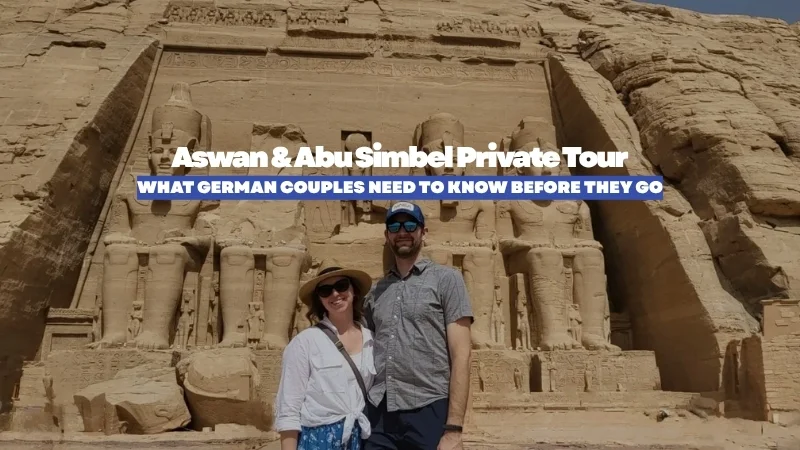
Abu Simbel is 280 kilometers further south, close to the Sudanese border. The two temples there — the Great Temple of Ramesses II and the smaller Temple of Hathor, dedicated to Queen Nefertari — were carved directly into a sandstone cliff around 1264 BCE. In the 1960s, when the construction of the Aswan High Dam threatened to submerge them beneath Lake Nasser, UNESCO coordinated one of the most complex engineering rescues in history: the temples were dismantled into 16,000 blocks, moved 65 meters uphill, and reassembled piece by piece. The project involved 50 nations and took four years.
The scale is genuinely difficult to grasp before you're standing in front of it. The four seated colossi at the entrance to the Great Temple each stand approximately 20 meters tall. Inside, the hypostyle hall extends deep into the cliff, lined with eight Osiris statues, its walls covered in relief carvings that document — and substantially embellish — Ramesses II's military campaigns.
The drive from Aswan to Abu Simbel covers 280 kilometers along a desert highway that runs roughly parallel to the western shore of Lake Nasser. The road is paved and open all day — there are no mandatory police convoys, no fixed departure windows, and no bureaucratic scheduling to work around. That system no longer exists.
What does exist is a de facto rush hour. Because most mass-market tour operations run on the same schedule, a large wave of buses typically departs Aswan between 04:00 and 05:00, arriving at Abu Simbel around 07:30–08:00. The site fills quickly. A private tour gives you the freedom to depart on your own terms — whether that means joining the early wave for sunrise at the temples, or timing a mid-morning departure to arrive as the large groups are leaving.
The drive itself takes approximately 3 to 3.5 hours in each direction. The first 100 kilometers are smooth; the road surface becomes more variable after that, with occasional stretches that are noticeably rough. An air-conditioned private vehicle is not a comfort upgrade — in temperatures that regularly reach 35°C or higher by mid-morning, it is simply what makes the journey manageable.
Departing before sunrise means experiencing the Saharan desert in a way most tourists never do. The air is sharp and cold at 04:00. The sky shifts from deep blue to amber to pale gold as you drive. Hotels in Aswan will often prepare a breakfast box for guests leaving this early — a small detail, but one worth requesting when you book.
EgyptAir operates scheduled flights between Aswan and Abu Simbel airport, with a flight time of approximately 40 minutes. Departures are limited — typically one or two per day — and schedules vary by season. Some private tour operators offer a fly-one-way, drive-the-other arrangement, which eliminates the longer road segment in one direction at the cost of added complexity and price. It is an option worth exploring if time is a significant constraint.
Lake Nasser cruises travel from Aswan southward to Abu Simbel over three to four nights... These cruises require a dedicated itinerary block and appeal to travelers who prioritize depth over efficiency.
However, if you want to combine the romance of a river journey with Egypt's coastal beauty and historic capitals, a comprehensive itinerary is the best approach. For German couples seeking a seamless luxury experience, you can explore the
The Temple of Philae, dedicated to the goddess Isis, stands on Agilkia Island and is reached by a short motorboat ride from the Shellal dock, about 8 kilometers south of central Aswan. Like Abu Simbel, it was relocated during the UNESCO campaign — lifted from its original island before the waters rose.
The approach by boat is worth the early start. The temple emerges from the water gradually, its pylons and colonnades framed by the Nile. Plan around 90 minutes for a thorough visit. The outer court, the mammisi (birth house), and the hypostyle hall each contain relief carvings that reward slow attention. A guide's familiarity with the iconography here — the specific relationship between Isis, Osiris, and Horus played out across the walls — determines how much you actually take away.

Often skipped in favor of another temple visit, the Nubian Museum in Aswan is among the better-organized archaeological collections in Egypt. It traces the history, culture, and forced displacement of Nubian communities from prehistoric times through the twentieth century. The museum is air-conditioned, well-lit, and rarely crowded. For couples trying to understand the human context behind what they're seeing at the sites, two hours here is time well spent.

A granite quarry at the southern edge of Aswan contains an obelisk that was abandoned mid-carving approximately 3,500 years ago, likely because a flaw appeared in the stone. It remains exactly where it was left. Had it been completed and erected, it would have been the largest obelisk ever made — 42 meters tall, weighing an estimated 1,168 tons. The site is relatively uncrowded and gives a concrete sense of the labor and technical precision involved in ancient construction.

An evening felucca ride among the islands near Aswan — Kitchener's Island, Elephantine, the western bank — is one of the quieter ways to end a day. The pace is slow, the boat is small, and the light changes quickly after sunset. It carries no historical content to absorb. It is simply time on the water, which after a day of temples is often exactly what's needed.

Arriving before the main wave of tour buses — around 07:00 to 07:30 — means reaching the site while the morning light still falls at a low angle across the colossi. The shadows are long. The stone is warm-toned in that hour, less bleached than it appears at midday. There may be thirty or forty people present rather than three hundred.
The Great Temple faces due east, and twice a year — around February 22nd and October 22nd — sunlight travels approximately 60 meters into the inner sanctuary and illuminates three of the four seated statues within. The fourth, representing the god Ptah, remains in shadow; his association with the underworld may have been intentional. These dates are believed to correspond to Ramesses II's birthday and his coronation. The phenomenon draws considerably larger crowds, so advance planning is essential if your dates align.
Inside the main temple, the walls narrate the Battle of Kadesh in relief — a conflict fought against the Hittites around 1274 BCE and one of the earliest battles in recorded history. Ramesses II's version of events, as depicted here, presents a decisive Egyptian victory. Historians have long debated whether that conclusion was accurate. The temple, unsurprisingly, does not. A knowledgeable guide is genuinely useful here: the carvings are dense and layered, and without context, much of the detail reads as decorative repetition rather than historical narrative.
The smaller temple, a few hundred meters to the north of the Great Temple, deserves more attention than most visitors give it. It was built by Ramesses II for his wife, Nefertari — not as a secondary dedication, but as a primary monument in her honor. The facade features colossal statues of both the king and queen standing at equal height, which is itself a departure from convention. An inscription above the entrance reads: "Ramesses II made this temple for the great wife whom he loves, Nefertari."
Inside, the painted reliefs retain much of their original color — deep ochre, turquoise, white, and black — preserved by the dry air of the desert. They are among the best-preserved examples of ancient Egyptian painting in existence. The subject matter moves between religious ceremony and what reads, given the context, as an intimate personal tribute.
For a couple visiting this site together, away from the noise of a large group, standing in that space carries a particular weight. The quiet matters here. A private tour provides it.
Aswan is one of the hottest cities in Egypt. Summer temperatures (June through August) regularly exceed 40°C by late morning, and the approach to Abu Simbel involves walking across exposed ground with limited shade. In that heat, the experience becomes physically taxing very quickly.
November through February is the most practical travel window. Daytime temperatures sit between 20°C and 28°C, and the mornings are genuinely cool — almost cold before sunrise. March and April remain comfortable, though temperatures climb noticeably by late April. May is the beginning of the difficult season.
Peak tourist season runs from October through April, which overlaps with the most comfortable weather. The crowd dynamic at Abu Simbel is predictable: the heaviest concentration arrives between 07:30 and 10:00, when the early-departure buses are on-site. After 10:00, as groups complete their visits and begin the return drive, the site thins out somewhat. Late afternoon arrivals — only practical for travelers staying overnight in Abu Simbel — encounter the lightest crowds of all, along with different light quality on the western-facing walls.
The colossi face east and are photographed best in the morning, when the sun is behind the camera rather than behind the statues. Interior photography in the Great Temple is challenging without high-ISO capability; the sanctuary is dim, and flash photography is prohibited. Spending less time trying to photograph the inner chambers and more time simply looking tends to result in a better experience of the space.
This is not about language preference in a casual sense. It is about comprehension depth.
A licensed Egyptologist guide explains Ramesses II's temple program in a way that connects architecture, theology, and political strategy. They read the cartouches on the walls. They explain why certain figures are depicted larger than others, what the color choices signify, why a particular god appears in a specific position. In English, this information is often accessible — many Egyptian guides are fluent and knowledgeable. But in your own language, working through complex historical and religious concepts is categorically easier. Nuance travels better.
Established operators like Kadmar Travel specifically provide licensed, German-speaking Egyptologist guides for private tours. The guide holds an official Egyptologist license issued by Egypt's Ministry of Tourism and Antiquities — a credential required for guiding at archaeological sites. This is not a tour leader who has learned some facts about the temples. It is a trained specialist who can respond to the specific questions a well-informed couple brings with them.
The practical consequence: conversations that go deeper, explanations that adjust to your level of prior knowledge, and a visit that doesn't require filtering everything through a second language.
For couples with a genuine interest in Egyptology — or simply travelers who want to understand what they're looking at — this is probably the single most significant differentiator between a private tour and a budget group option.
A group excursion to Abu Simbel from Aswan is significantly cheaper — often available for €35–65 per person through local operators, or bundled into a Nile cruise package. It covers the distance, delivers you to the site, and gets you back. For straightforward sightseeing on a budget, it functions adequately.
A private tour costs considerably more — typically €150–300 per couple for an Aswan day, with Abu Simbel priced separately depending on what's included. Here is what the additional cost actually buys:
Departure timing: You choose when to leave, with the flexibility to avoid the early-morning bus cluster or to time arrival for a specific light condition
Pace on-site: No group schedule means spending 45 minutes in the Temple of Nefertari if you want to, rather than 15
Vehicle comfort: Private air-conditioned car versus shared bus on a 280-kilometer desert road
Language: A German-speaking licensed Egyptologist rather than an English-only group guide
Intimacy: The absence of 30 strangers standing next to you in a space that is more meaningful when it is quiet
Flexibility: Breakfast box from the hotel, a stop where you want, a return schedule that fits your day
For couples who travel selectively and find that the quality of a visit matters as much as the fact of it, the calculation tends to favor the private option. For travelers primarily interested in seeing the site rather than experiencing it in depth, the group tour is a reasonable choice.
The desert at 04:00 is cold. This surprises almost everyone who hasn't done it. Even in October and November, the air before sunrise in southern Egypt is sharp — bring a light jacket or a layer you can remove once the sun is up. The temperature shift between 05:00 and 09:00 is dramatic.
Ask your hotel to prepare a breakfast box. Restaurants in Abu Simbel are limited and not particularly good. Most hotels in Aswan will put together a simple breakfast package for early departures if asked the evening before. Eating in the car on the way is far preferable to the options available at the site.
Carry Egyptian pounds for tips and small purchases. There are no ATMs at Abu Simbel. Vendors accept euros and dollars, but at exchange rates that consistently favor the vendor. Small amounts of local currency — for water, a small purchase, tipping a site staff member — make those transactions simpler. Withdraw in Aswan the day before.
Inside the Great Temple: look up. Most visitors focus on the walls. The ceiling of the hypostyle hall is painted with flying vultures — a detail that is easy to miss and genuinely striking. Your guide should point it out; if they don't, ask.
Is staying overnight in Abu Simbel worth it?
For couples who want to see the temples in late afternoon light and again the following morning — both considerably quieter than the midday rush — an overnight stay changes the nature of the visit entirely. The Seti Abu Simbel Lake Resort is the most established accommodation option near the site. The town itself is small and offers very little beyond the temples, so the decision is essentially: do you want two visits with a night in between, or one visit and the same-day drive back? Many travelers who have done both say the overnight version is worth it.
How physically demanding is the trip?
The drive — roughly 3 to 3.5 hours each way — is the most fatiguing element. At the temples, the terrain is mostly flat and paved. The interior of the Great Temple requires no climbing, though the space becomes progressively more enclosed as you move toward the inner sanctuary. For travelers with mobility concerns, Abu Simbel is more accessible than much of Luxor, where some tombs involve steep descents on uneven stone steps.
What should a reliable private tour from Aswan to Abu Simbel include?
At minimum: private air-conditioned vehicle, licensed Egyptologist guide (with documented credentials, not just a tour leader), entrance fees to both temples, hotel pickup and drop-off, and water for the road. Meals are typically excluded. German-speaking guide availability should be confirmed explicitly at the time of booking, not assumed. Get the full inclusions in writing before any payment is made.
Aswan and Abu Simbel are not interchangeable destinations. Aswan is a city worth slowing down in — a place with texture, history, and a distinctly Nubian character that rewards attention. Abu Simbel is a specific, purposeful journey to see something that shouldn't exist but does: two ancient temples that were cut from a cliff, moved uphill, and reassembled so precisely that the solar alignment still works.
A well-organized private tour with a licensed German-speaking Egyptologist gives you more than convenience. It gives you the pace to look carefully, the language to understand what you're seeing, and the quiet — particularly in the Temple of Nefertari — to let the place actually register.
That combination is not standard. It requires choosing deliberately. For couples who are making that choice, southern Egypt is likely to deliver exactly what they came for.
Southern Egypt rewards travelers who slow down enough to experience it properly. For couples interested in private, German-speaking Egyptologist-guided tours through Aswan and Abu Simbel, Kadmar Travel offers customized itineraries designed around flexibility, depth, and quieter travel experiences.
Ready to embark on your Egyptian adventure? Contact Kadmar Travel today and let us turn your travel dreams into reality.
Reach out to our dedicated team at Inbound@kadmartravel.com or call us at +2034839726
Reach out to our dedicated team at Inbound@kadmartravel.com, call us at +2034839726, or contact us through WhatsApp at +201286739037.
Don't just visit Egypt; experience it with Kadmar Travel
Or fill out the form below and we will call you back for any information needed.